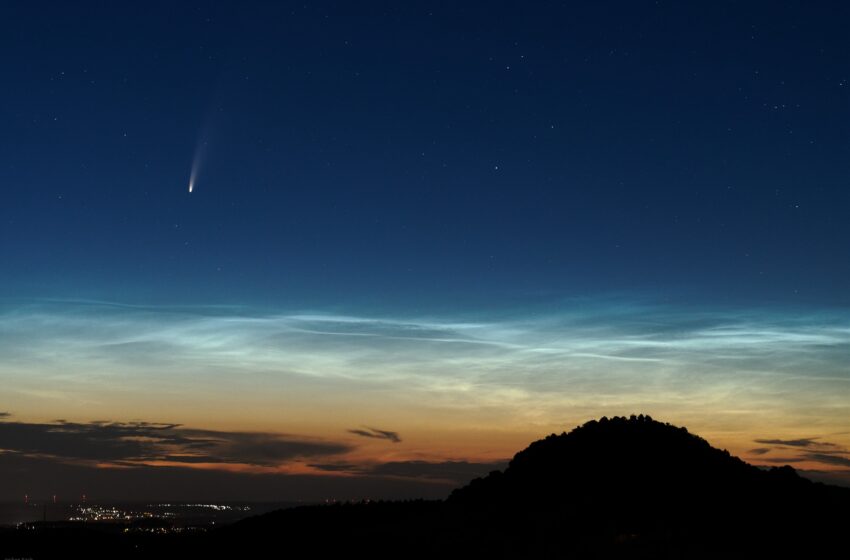
The comet is made of ice and dust and emits a greenish aura, and is estimated to have a diameter of about a kilometre.
A comet that will shoot past Earth and the Sun in the coming weeks for the first time in 50,000 years could be visible to the naked eye. The comet is expected to pass nearest to Earth on February 1 and will be easy to spot with a good pair of binoculars or even with the naked eye, provided the sky is not too illuminated by city lights or the Moon Jupiter in March last year.
Thomas Prince, a physics professor at the California Institute of Technology who works at the Zwicky Transient Facility, told AFP that the comet’s proximity to the Earth made it easier for telescopes to measure its composition “as the Sun boils off its outer layers”. This “rare visitor” will give “us information about the inhabitants of our solar system well beyond the most distant planets”, he added. Prince said another opportunity to locate the comet in the sky will come on February 10, when it passes close to Mars.
Rare visitor: The comet has spent most of its life “at least 2,500 times more distant than the Earth is from the Sun”, Prince said. Biver said the comet was believed to have come from the Oort Cloud, a theorized vast sphere surrounding the Solar System that is home to mysterious icy objects.
Nearest to Earth on February 1
After travelling from the icy reaches of our solar system it will come closest to the sun on January 12 and pass nearest to Earth on February 1. It will be easy to spot with a good pair of binoculars and likely even with the naked eye, provided the sky is not too illuminated by city lights or the Moon. The comet “will be brightest when it is closest to the Earth”, Thomas Prince, a physics professor at the California Institute of Technology who works at the Zwicky Transient Facility, told AFP.