A stronger immigration system is necessary. But Ireland must be careful that solving one problem does not create another.
Ireland is entering an important new phase in its immigration and citizenship policy.
The Government has approved the priority drafting of major reforms to Irish citizenship legislation. Among the proposals are increasing the general qualifying residence period for naturalisation from five years to eight years, introducing English, Irish or Irish Sign Language proficiency requirements, introducing a test covering Irish civics, society and politics, and requiring applicants to demonstrate economic self-sufficiency.
The Government’s argument deserves to be understood.
Ireland has experienced rapid population growth and significant pressure on housing, accommodation, public services and the international protection system. A country has both the right and responsibility to control its borders, protect the integrity of its immigration system and ensure that citizenship represents a genuine and lasting connection to the State.
Stronger action against illegal immigration, abuse of the asylum process, deliberate breaches of immigration law and fraudulent applications should therefore not automatically be characterised as anti-immigrant.
A fair immigration system must also be an enforceable immigration system.
However, there is another side of this debate that Ireland cannot afford to overlook.
Immigration and Skilled Immigration Are Not the Same Debate
One of the greatest risks in the current political discussion is putting very different categories of migrants into the same basket.
A person entering or remaining in Ireland unlawfully is not in the same position as an engineer, doctor, nurse, cybersecurity specialist, software developer, construction professional, researcher or other skilled worker whom Ireland has deliberately invited through its legal employment permit system.
Ireland is still actively changing its employment permit system because important sectors cannot find enough workers.
In May 2026, the Government announced changes to employment permits specifically to address continuing labour and skills shortages in areas including healthcare, construction, transport and agri-food.
That creates an important policy question:
If Ireland needs international talent badly enough to actively recruit it, should those same people face an increasingly uncertain and lengthy path towards making Ireland their permanent home?
This is where immigration control and economic strategy must work together.
The Political Reality Cannot Be Ignored
There is also clearly a political dimension to immigration policy.
Immigration has become one of the most sensitive political issues across Europe. Governments are under pressure from voters concerned about housing, public services, asylum numbers, integration and the speed of demographic change.
Minister for Justice Jim O’Callaghan has said that the reforms are intended, among other things, to retain the support of “common sense reasonable people” for migration and citizenship.
That tells us something important.
Immigration policy is no longer simply an administrative or economic issue. It has become an electoral issue.
A Government responding to legitimate public concern is not inherently wrong. In fact, failing to respond can create even greater political division.
But policy designed to restore public confidence must be carefully targeted.
There is a danger that measures intended to demonstrate political toughness on migration have consequences for people who were never the source of the problem in the first place.
The People Most Disrupted May Be the People Ireland Wants to Keep
Consider the position of a skilled professional who legally moved to Ireland.
- They obtained an employment permit.
- They passed immigration checks.
- They accepted employment in an area where workers were needed.
- They rented or purchased a home.
- Their children entered Irish schools.
- They paid PAYE, PRSI, VAT and other taxes through their everyday economic activity.
- They built friendships, careers and businesses.
- They planned their future around the immigration framework that existed when Ireland invited them here.
- For such people, citizenship is not simply about obtaining another passport.
- It represents certainty.
- It allows a family to say:
- Ireland is finally our permanent home.
Changing the qualifying period from five years to eight years may therefore appear relatively small on paper, but for a family planning its life, another three years of immigration dependency can be significant.
It can affect career decisions, mortgages, investment, children’s futures, entrepreneurship and ultimately the decision about whether to remain in Ireland at all.
Self-Sufficiency Is Reasonable But It Must Be Designed Carefully
The principle that people seeking naturalisation should demonstrate a reasonable degree of self-sufficiency is understandable.
Citizenship is a serious commitment between an individual and a country.
But Ireland should be extremely careful about creating a simplistic division between people who have received State assistance and people who have not.
Not every welfare payment represents dependency.
A person can work for many years, pay substantial taxes and temporarily require assistance because of redundancy, maternity, illness, disability, family circumstances or an economic downturn.
Indeed, reports about the proposed reforms indicate that some universal or contribution-related supports, including Child Benefit and Maternity Benefit, are unlikely to operate as automatic barriers.
The final legislation therefore needs proportionality, clearly defined criteria and appropriate exceptions.
The objective should be to identify sustained economic dependency where relevant — not punish ordinary working families for temporarily using a social protection system they themselves helped finance.
Ireland Should Reward Contribution
There is an opportunity here to make the citizenship system stronger rather than simply harder.
Instead of viewing every applicant primarily through the number of years they have physically spent in Ireland, Ireland could place greater emphasis on the quality and continuity of their contribution.
- Lawful residence should matter.
- Employment should matter.
- Tax contributions should matter.
- Entrepreneurship and job creation should matter.
- Professional skills should matter.
- Community participation should matter.
- Good character should matter.
- Language and integration should matter.
- Compliance with immigration law should matter.
These are meaningful indicators that somebody has genuinely become part of Irish society.
An eight-year waiting period does not automatically produce better integration than five years. The real question is what someone has done during those years.
Ireland Is Competing for People
This is perhaps the most important economic consideration.
Ireland is not choosing skilled migrants in isolation.
Skilled migrants are also choosing Ireland.
A software engineer, medical specialist, AI professional, cybersecurity expert, researcher or experienced entrepreneur may have opportunities in several countries.
They compare salaries, taxation, housing, education, family reunification, permanent residence and citizenship pathways before relocating their families.
Predictability matters enormously.
If Ireland becomes perceived as a country where the immigration pathway can significantly change after someone has already relocated, professionals may increasingly consider competing destinations.
The damage would not necessarily appear immediately.
It could emerge gradually through recruitment difficulties, fewer international specialists accepting Irish positions, existing professionals relocating elsewhere and entrepreneurs deciding to establish businesses in countries offering greater long-term certainty.
What Could Ireland Lose?
Ireland’s economic success has been built partly on openness: openness to investment, international business, education, ideas and talent.
If citizenship and immigration reforms are not carefully balanced, Ireland risks losing some of the very people its employment permit system is trying to attract.
That could mean losing experienced healthcare workers from an already pressured health system; technology professionals supporting Ireland’s position as a European technology hub; engineers and construction specialists needed to deliver infrastructure and housing; entrepreneurs creating businesses and employment; and internationally experienced professionals contributing knowledge, taxes and economic activity.
There is also a less visible loss: confidence.
Once skilled international professionals begin to believe that long-term settlement in Ireland is unpredictable, rebuilding that confidence can be considerably harder than changing legislation.
Strong Borders and Skilled Migration Can Coexist
Ireland should not have to choose between controlling immigration and welcoming skilled migrants.
It can do both.
Ireland can operate strong borders.
Ireland can process asylum applications quickly.
Ireland can remove people who have no lawful entitlement to remain after due process.
Ireland can act against immigration fraud.
Ireland can require respect for Irish law and society.
Ireland can expect integration and reasonable self-sufficiency.
And at exactly the same time, Ireland can tell the doctors, engineers, nurses, researchers, tradespeople, technology specialists, entrepreneurs and other lawful migrants it needs:
If you come legally, contribute, integrate, respect our laws and build your life here, Ireland will provide you with a fair, transparent and predictable pathway to belonging.
Those positions are not contradictory.
They are the foundations of a mature immigration policy.
The Better Direction for Ireland
The objective of immigration reform should therefore not simply be fewer immigrants or fewer citizens.
It should be a better-managed system.
Ireland needs to distinguish clearly between humanitarian protection, irregular migration, temporary migration and economic migration.
Enforcement resources should focus strongly on illegal immigration, fraudulent applications and abuse of the international protection system, while lawful economic migrants should have predictable pathways based on residence, contribution, integration and good character.
Most importantly, people already legally resident in Ireland deserve careful consideration where they made major life decisions based on the rules that existed when they arrived.
This is not an argument for weak immigration control.
It is an argument for intelligent immigration control.
Ireland has every right to protect its borders, public finances and citizenship. But it also has an economic responsibility to protect its reputation as a country where talented people can come legally, work hard, contribute and eventually belong.
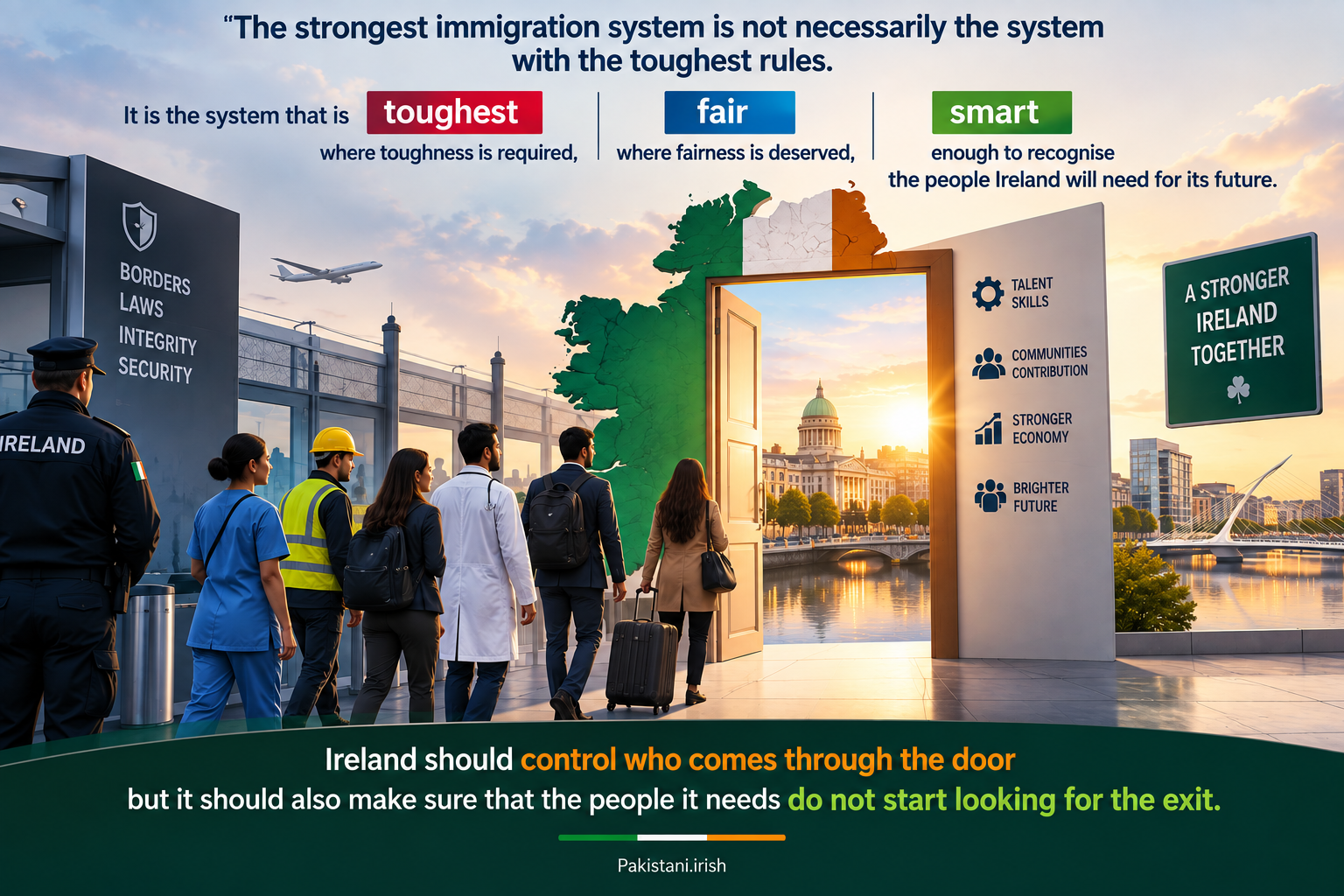
The strongest immigration system is not necessarily the system with the toughest rules.
It is the system that is toughest where toughness is required, fair where fairness is deserved, and smart enough to recognise the people Ireland will need for its future.
Ireland should control who comes through the door — but it should also make sure that the people it needs do not start looking for the exit.
— Atif Bangash
Pakistani.irish